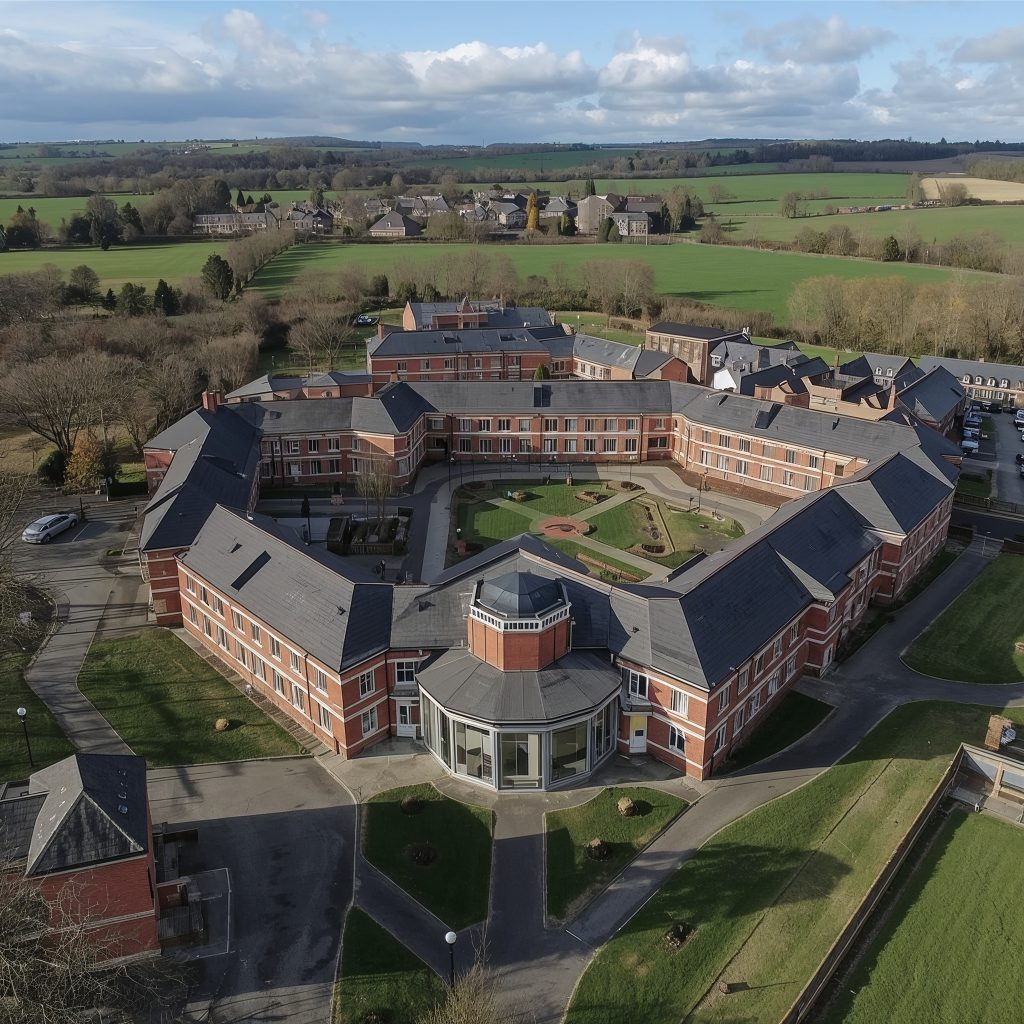
The school wore its newness like a scab: red brick raw against the sodden green of February, blank-eyed windows reflecting the winter sky, the air around it sharp with the ozone of scrubbed floors and bleach. The taxi driver, a man so resolutely featureless he seemed designed for forgettability, dumped Julia and her suitcase at the gravel path. There was no welcoming committee; just a chalked sign that said Reception with an arrow pointing east.
Inside, the floors gleamed as if still wet. The corridors stretched in every direction, punctuated by fire doors and the low-grade hum of fluorescent tubes. Julia advanced by increments: five steps, then wait, then another five. She had rehearsed this journey in her mind for weeks, always with variations—a teacher would greet her and usher her through, or a knot of girls would block her way, or someone would ask if she was lost. In reality, there was only the receptionist, who looked up without a smile and checked her name off a list with a red biro.
“You’re in Malvern. That’s the blue block,” the woman said. She handed over a key on a ribbon, a map, and a thin manila envelope. “Your mother’s sent forms. You’ll need to bring those to admin after lunch.”
Julia nodded, but the woman was already back to her screen.
The walk to Malvern took her across a dead quadrangle, the grass fenced off with rope and warning tape (“Turf Under Repair—Do Not Enter”). She followed the path by the map, half-expecting someone to step out and redirect her, but she met only a murder of crows, pecking at some unseen thing in the mud. The air was damp and it pressed against her clothes, making them cling. The only noise was the distant drone of a leaf blower.
The blue block looked exactly like every other building, but the door was unlocked and the heating was set so high the air inside tasted of hot dust. Each room off the corridor was labeled with a whiteboard: pairs of names in colored marker, separated by an ampersand as if announcing an act. Julia & Victoria, Room 204.
The door was ajar, just enough that she could hear the inside before she saw it. A girl’s voice, brittle and certain: “No, but she’s literally a ghost. I googled her and got nothing except two chess scores and a photo from 2013.” Another girl laughed, a weaponized titter. “Are you sure she’s even real?”
Julia considered her options and, for the briefest moment, entertained turning back. Instead she knocked, twice, and entered.
Victoria was perched on the desk, one leg folded up, the other swinging in a metronome arc. Her blonde hair was wound into a perfect French braid, her uniform modified in the allowable ways: top button undone, sleeves pushed up to reveal the tan line from her tennis watch. There was an instant, the very instant Julia entered, when Victoria’s face flickered through a dozen micro-expressions before settling on an amused blankness.
“Hi,” Julia said, setting down her suitcase on the bed nearest the window.
Victoria uncrossed her arms, but not her legs. “Welcome to Malvern. I’m Victoria, obviously.”
The other girl—red-haired, rawboned, with a face full of sharp edges—gave a little wave. “Helena. I’m next door.”
Julia nodded, but said nothing.
Victoria watched her, head tilted, as Julia began the silent process of unpacking: uniforms in the wardrobe, toiletries on the shelf, notebooks stacked on the desk in order of subject. It was a well-rehearsed ritual, a choreography for invisibility. She ignored the way Victoria tracked her every movement, like a cat observing a new arrival.
After a long minute, Victoria spoke. “So, where are you from?”
It was the question everyone asked, but it was also a test. Julia looked up. “Ludlow area,” she said. “South Shropshire. Near the border.”
Victoria smiled, all teeth. “Oh, so you’re basically Welsh.”
Helena snorted. “She doesn’t sound Welsh.”
“Give it time,” Victoria said, “she’ll pick it up. Everyone here does. Especially the sheep jokes.”
Julia forced a smile. “I’m not very good at jokes.”
Victoria hopped off the desk, closing the distance with two steps. She was taller than Julia by at least two inches, and she used it. “Well, you’ll have to get good at something,” she said. “Most girls here either do sports, or drama, or languages. Or they do, you know—people. Are you, like, academic?”
“I like maths,” Julia said. “And computers.”
Victoria did the slow blink of someone reframing a threat. “You’ll get on with the STEM crowd, then. They’re mostly in Upton block but you can join their clubs if you want. I’m lead in the play, and captain of tennis. Not that you’d want to try out, probably.”
Helena said, “They’re not scary, the sports girls. But it’s pretty full-on. Like, a lot of running around at night.”
Victoria leaned closer, voice lowered. “If you ever need anything, or anyone bothers you, come find me. We take care of our own.”
Julia nodded again, tucking her hands in the cuffs of her cardigan. She recognized the rhythm, the hierarchy. There were always Victorias: the ones who set the rules and claimed the territory, who mapped every interaction as an extension of their own influence.
Victoria gave a little snort, not quite laughter. “Seriously, you’re like a bird that fell out of the nest. Are you always this—” she gestured, taking in Julia’s slightness, her pale wrists, the curtain of hair, “—tiny?”
“Sometimes,” Julia said.
Helena giggled, but there was something softer in her eyes, a kind of pity or perhaps a hint of shared unease.
Victoria’s phone chimed. She ignored it. “We have registration in ten, then double history. Do you have the timetable yet?”
Julia fished the schedule from her envelope, unfolding it with careful precision. “It’s here.”
“Let me see.” Victoria snatched the paper and scanned it, her finger tracing the blocks. “You’re with us for history, English, and PSHE. Maths is in the old annex, so you’ll have to get used to the stairs. Assembly is Wednesdays. Lunch is at twelve, but the queue starts at eleven forty, unless you have a pass.”
She handed the timetable back, a smirk on her face. “Stick with me, or you’ll get lost. Literally. The building is a maze and no one will come find you if you go missing.”
Julia smiled, this time with an edge of her own. “I have a good sense of direction.”
Helena grinned. “Bet you five quid she finds the canteen before Victoria.”
Victoria raised an eyebrow. “Bet you ten she gets lost in the gym changing rooms and ends up in the boys’ block.”
They all laughed, and for a moment Julia felt the ice thin just enough to make the world navigable. She glanced out the window at the quadrangle, the crows now gone, the grass still roped off. In the reflection, she saw the three of them: Victoria in the foreground, radiant and self-satisfied; Helena, angular and hungry-looking; and herself, a blurred shadow at the edge.
Victoria checked the time. “Grab your books. We’ll go early so you can see where the classrooms are.”
Julia picked up her notebook, the one her mother had insisted on (“You should keep a diary, darling, it helps process transitions”). She slipped it into her satchel.
As they left, Victoria glanced back at Julia’s bed, at the careful lines of the blanket and the perfect parallel of the pillow. “You’re neat,” she said, as if accusing her of something.
Julia didn’t reply.
The corridor was brighter than she remembered, the light from outside refracting through glass bricks and catching every mote of dust. The three of them moved as a unit, Victoria in the lead, Helena flanking, Julia trailing but always watching.
At the staircase, Victoria turned, eyes catching Julia’s. “Just so you know, some of the girls are… territorial. If anyone says anything, tell me, okay?”
Julia nodded, but inside she was cataloguing the warnings, annotating every interaction for future use. She’d survived worse than this. She’d survived her mother’s indifference and her grandmother’s razor-sharp lessons and the endless, echoing silence of her own house after dark.
They reached the classroom with time to spare. Victoria staked out a spot at the front, dropping her bag onto a chair and claiming the table beside it. Helena took the seat behind, leaving Julia to choose: wedge in at the front, or retreat to the back where the other girls already clustered.
Julia chose the middle. It was safer, and from there she could see everything.
The teacher arrived, a man with thin hair and a voice like shredded paper. Victoria and Helena greeted him by name. Julia watched, saying nothing.
By the end of the lesson, she had mapped the seating chart, identified three distinct factions, and memorized the route back to her dorm.
During break, Victoria cornered her at the lockers. “Don’t take it personally if people are weird. They just hate new kids, especially ones who come in late.”
Julia said, “I don’t mind being invisible.”
Victoria paused, really looked at her. For a moment the bravado cracked and she saw something else—a recognition, maybe, of another kind of predator. But then it passed, and Victoria smiled again, brighter than ever. “Invisibility is a power,” she said. “Use it.”
Julia nodded, and did.
By evening, Julia had her bed made, her schedule memorized, and a running inventory of every girl in her year. She lay on her side in the dark, listening to the murmur of voices through the thin walls. She heard Helena giggling next door, the metallic snick of a lighter, the drift of whispered insults and declarations of love and plans for the weekend.

On the desk, her mother’s latest letter, unopened. She ignored it.
Instead, she pressed her ear to the cool plaster and listened.
Everything was data. Everything was leverage.
By the third night, she had learned how to move silently through the corridors after lights out, how to make it to the common bathroom without triggering the motion sensor, how to fold her body into the smallest possible space to avoid detection.
It wasn’t survival. It was preparation.
She would wait, and watch, and one day soon, the balance would tip.