Category: Prologue

  • 20220517 Prologue 3

    20220517 Prologue 3

    This entry is part 3 of 17 in the series Journey to Linger

    BACK TO WORK

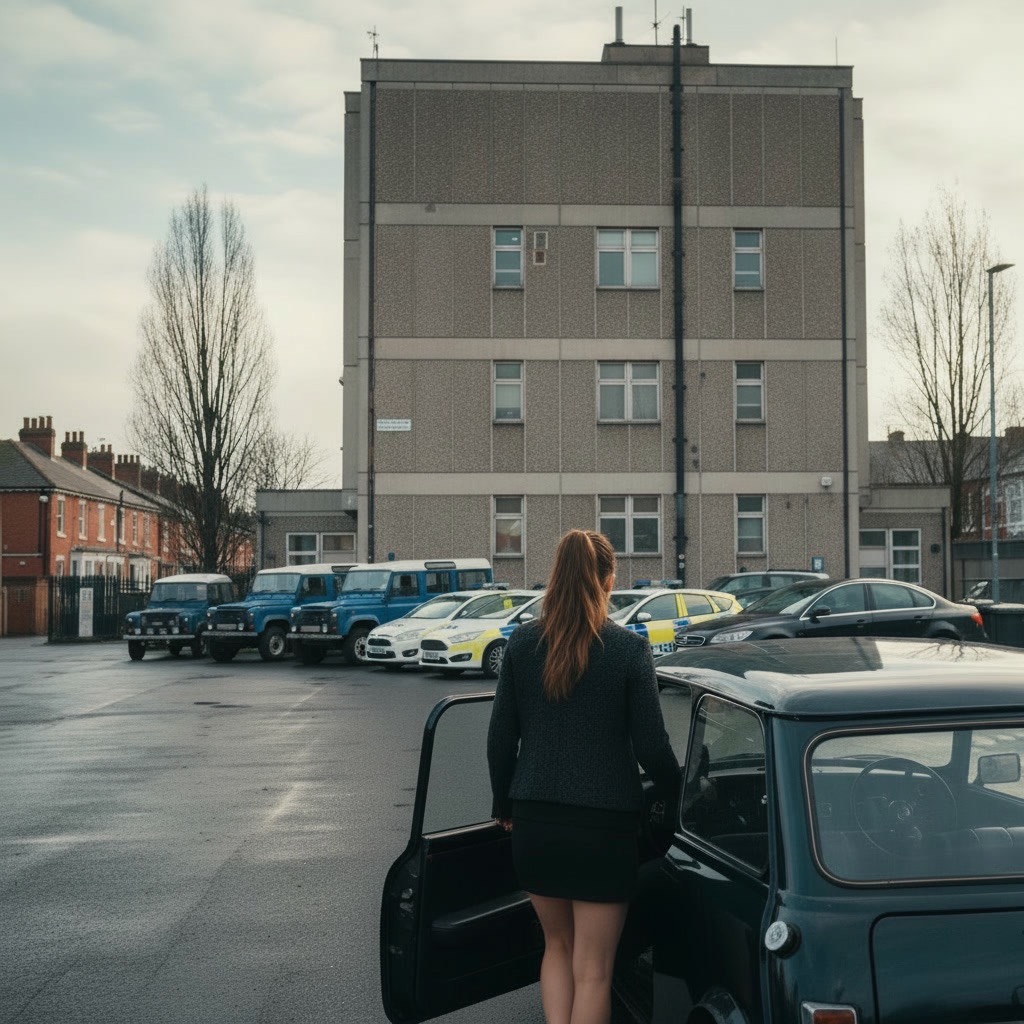
    he drive to work was a purification. The car—a battered Mini Cooper with hairline cracks radiating from the edges of the windscreen—functioned as a kind of mobile airlock, a membrane separating her private night world from the public rituals of the day. She never listened to music in the mornings, preferring instead the controlled astringency of audiobooks. Lately she’d been cycling through police procedurals: a litany of small-town murders and world-weary detectives, their tidy resolutions as comforting as the heat from the car’s ancient vents. She could predict the culprit by the third chapter and sometimes found herself mentally rewriting the crime scenes, annotating the author’s mistakes, cataloguing the lazy patterns.

    Today the voice in her ear was a woman—northern accent, crisp, an undertone of impatience in every vowel. The book’s hero, a recently divorced DCI with a penchant for lurid metaphors, was currently standing in a kitchen examining a blood pattern on a laminate floor. She tuned it out after the first few sentences; the reality was rarely so neat, and anyway, she was more interested in the tangibility of the steering wheel, the way the frost had left veins along the hedges, the way the low sun blurred the horizon into an endless, surgical white.

    At the roundabout, she found herself thinking about Gary—not the man himself, but the aftermath, the way he’d gone so limp, as if the simple act of being seen by her had rendered everything else unnecessary. She’d felt no remorse. That was the part people never understood. Not a lack of empathy, but a lack of shared language for what this was. Some people needed to test boundaries in order to feel real; others were content to be shaped by the force of another’s will. Gary had always wanted to be told what to do. All his bravado on the forums, his showy arguments about rules, his obsession with miniature worlds—it was all the posture of someone desperate to be possessed by a stronger gravity. She’d provided it. Simple as that.

    She pulled onto the bypass, the car trembling as it picked up speed, and let her thoughts drift back to the first time she’d truly noticed this tendency in herself. That was years ago, before university, before the persona of self-sufficiency had hardened into habit. It was at St Teresa’s, the boarding school, in the long shadowed corridor outside the sports block. The details came back with photographic clarity: the damp wool of her uniform, the chemical tang of industrial floor cleaner, the way sunlight carved the world into binaries of seen and unseen. There had been a girl, Victoria, a year older, who’d set out to bully her. She had searched for her and was now towering over her about to demand money and “tributes”.

    She had responded with a single sentence. 

    She remembered the look Victoria’s eyes—no fear, just confusion, like a kitten being held by the scruff for the first time. 

    While Victoria still reeled in shock, she had explained in slow, quiet words how the world was full of hidden things, how some people were made for collecting secrets, and how others existed only to be used and then discarded. The next day, Victoria had gone to the nurse, transferred to a different student block and never spoken to Julia again. A clean break, a neat incision.

    Now, as she neared the office, she felt that same internal clarity, the hush that followed a successful operation. She parked, checked her face in the rearview (eyes a little red, but that could pass for allergies), and applied the minimal makeup required for plausible normalcy. She shouldered her bag and walked toward the entrance, counting the familiar landmarks: the scuffed step by the fire door, the rusty patch on the bin, the slanted shadow of the security lamp on the brick. It was all as she’d left it.

    Inside, the corridors hummed with pre-9 a.m. energy—phones already ringing, the air thick with instant coffee and unresolved tension. Julia slipped into her cubicle, hung her coat, and logged in. The first emails were already waiting: requests for information, invitations to meetings, a passive-aggressive note from the facilities manager about fridge etiquette. She replied to each with the proper mixture of efficiency and inoffensiveness, taking care to make her answers just helpful enough to reinforce her reputation as “reliable but not a threat.”

    She opened a browser tab and checked the news. There was nothing about Gary, of course. She’d left the body in such a way that the process would take time, maybe weeks before it was discovered. The real challenge wasn’t in the act itself but in the waiting afterward: keeping her affect flat, monitoring the drip of information, being prepared to act if something went awry. She never took trophies—too obvious—but she allowed herself the occasional small indulgence. This time it was the memory of his breathless, wide-eyed confusion, the certainty that he was finally the protagonist of his own story.

    A knock at the cubicle wall.

    She turned to see her manager— David, today in his “Tuesday shirt,” a blue check pattern that made him look like a cartoon farmer.

    “Morning. How’s the evidence in the Henderson case going?”

    She forced the proper smile. “On track. I sent you the update last night.”

    He grunted, pleased, and moved on. She watched him go, thinking how little he would understand, how utterly predictable his own secrets were. His online gambling. His interest in fetish sites. 

    She turned back to her screen and glanced at the task list. A dozen small fires to put out before lunch, a client call at eleven, and, if she was careful, at least an hour free to begin the next phase of her plan.
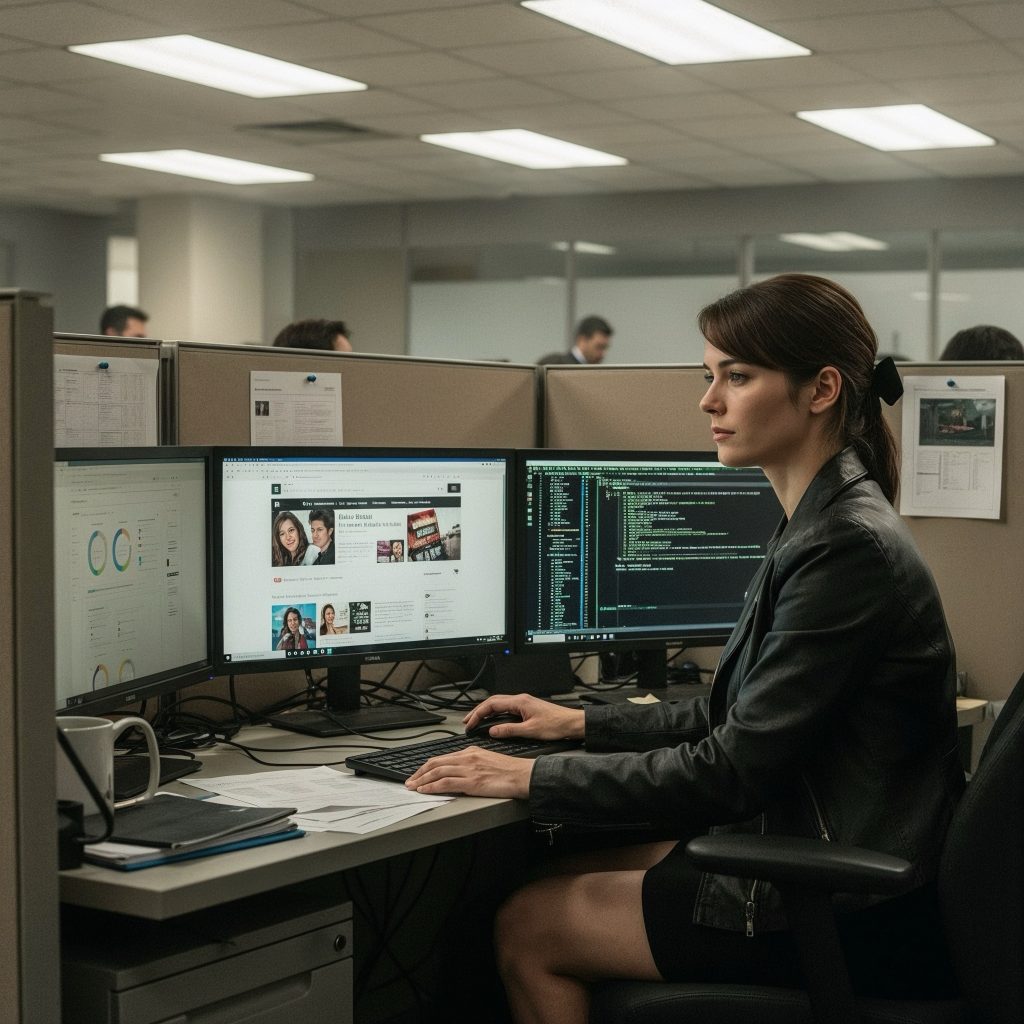
    At her desk

    She thought of the old tunnel, the body cooling in the dark, the way the mist had closed behind her like the cover of a book. She thought of St Teresa’s and the lessons she’d learned there.

    She wondered, not for the first time, whether any of this could be traced back to a single moment—a choice, a crossroads, a point at which the outcome was still in doubt.

    She doubted it.

    But she liked to imagine otherwise. Thinking about Victoria in the car had sparked her memory and with nothing challenging to do she thought back to when it had all begun. 
  • 20220516 Prologue 2

    20220516 Prologue 2

    This entry is part 2 of 17 in the series Journey to Linger

    JOB DONE

    She dragged him the rest of the way, his body already slack and compliant. The tunnel was just as she remembered from her last visit, maybe drier, the walls almost warm from the unseasonable weather. She made efficient work of the prep, first stripping him down, then positioning him on the plastic she’d laid out during her initial scouting run. The interior rituals had their own gravity, their own rhythm; she worked in silence, thinking of nothing in particular except the need for efficiency and the avoidance of evidence.

    She’d read, somewhere, that serial behavior was a function of neural pathways: the repetition was both a reinforcement and a reward. She’d always scoffed at the pop psych explanations, but in this moment, kneeling over the cooling body of a man who’d followed her into the dark with open, hopeless faith, she wondered if maybe it was just that simple.

    This one had been easier than the others. No desperate struggle, no pleading, just a sort of mute acceptance. She almost respected him for it.

    She finished the cleanup, and moved the body into the secondary chamber—an old offshoot of the main tunnel, hidden from even the most diligent searcher. She’d scouted and used it before, drawn by her mother’s stories of the old mineworks, and had chosen it for its combination of obscurity and ease of access. She doubted the bodies would ever be found, but if it was, she’d left nothing to connect it to her. Not this time.

    She dressed in what she called her “work clothes” with the long dark wig and emerged into the night, her hair damp with mist, her clothes reeking of mud and old stone.

    On the ridge above, the world went about its business—cars passing on the lane, the faint flicker of a television behind frosted glass, somewhere a dog barking at nothing. She retraced her steps to the churchyard and retrieved the orange Sainsbury’s bag for life. Flowers, chocolate and Prosecco. A moment of regret? No.

    She climbed the hill, boots squelching, and took a long, slow breath. The air tasted of iron and ozone.

    She felt, as always, a complex blend of regret and release. The regret was sharp and bright, but the release was deeper, a softening of the knot that had grown tight in her chest over the weeks of planning and anticipation.

    She walked back to her car, pausing at the stile to look down into the hollow, half-expecting to see some sign of her passage—a trail of flattened grass, a shoe lost in the bog—but there was nothing.

    The mist had already closed over the path, erasing every step. Her car, an old black Mini stood alone in the isolated lane away from the main road. 

    She got in, started the engine, and drove away. For a moment, as the headlights cut through the dark and gathering mist, she imagined she saw him standing at the edge of the woods, waving.

    But of course that was impossible.

    She had a new quest now.

  • 20220516 Prologue 1

    20220516 Prologue 1

    This entry is part 1 of 17 in the series Journey to Linger

    NUMBER THREE GARY

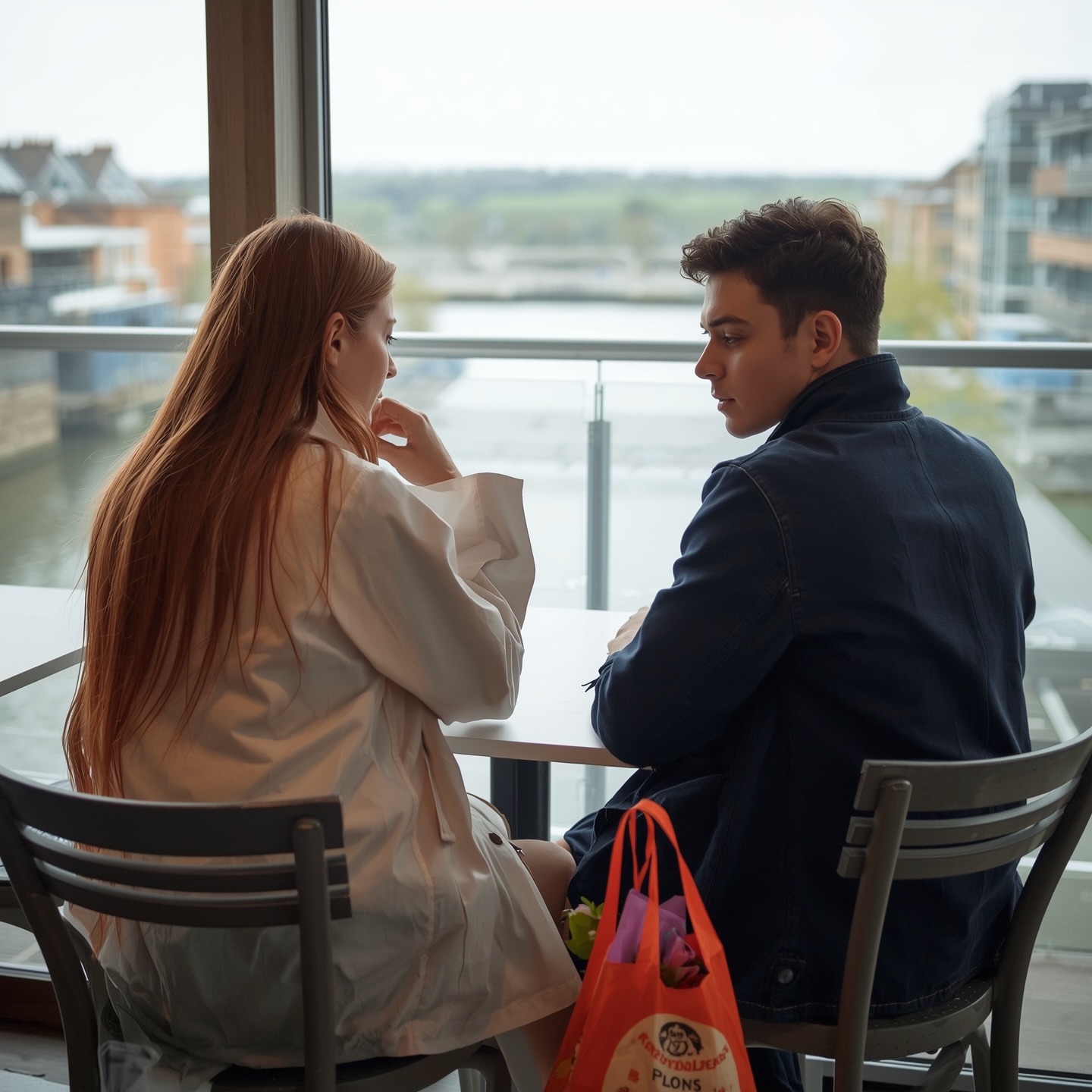
    In fact he had seen her online for nearly a month before the first in-person meeting, and he’d studied the profile with an obsessiveness that embarrassed even him. It had started as a dare, really—a sort of ritual humiliation in the forums, the way the regulars encouraged each other to try out “real world interactions” as if they were play-testing some new scenario module. He’d spent days composing and revising the perfect opener, something that would stand out in the blur of DMs, and it must have worked, because she’d answered within an hour. The next days were a headlong dive through the digital courtship: equal parts measured conversation and tense waiting for her reply, watching the ellipsis blink and vanish, then reappear. And then she’d asked to meet.

    He’d nearly called it off three times before actually getting on the train. It wasn’t even nerves so much as the certainty that she’d be disappointed, that something about his in-person self would register as a category error and she’d quietly withdraw, leaving him adrift in whatever provincial coffee shop she’d chosen. But there she’d been, punctual and more attractive than the filtered photos, and they’d talked for two hours without any of the expected deathly silences. She’d laughed at his jokes, though sometimes with the arch amusement of someone cataloguing specimens, and she’d seemed genuinely interested when he explained his latest campaign design. He’d left the cafe giddy and confused, convinced that something—maybe the quiet desperation in his eyes, maybe his encyclopedic knowledge of Barrowmaze lore—had actually worked in his favor.

    The invitation to see the country churchyard had felt like a test, a deliberate escalation, but he’d accepted with the logic of someone who’d already spent years being tested and had nothing to lose. He’d assumed it would be a brief walk, maybe a few awkward minutes of squinting at mossy gravestones before she ghosted him with polite finality. Instead, she’d led him past the church, through a thicket of yew trees, down into a hollow thick with mist and the muffled drip of rain from unseen branches. She’d walked ahead, silent but not unfriendly, until they reached the stone stile at the field’s edge and she’d stopped, turned to him, and smiled.

    And then everything had gone off-script.

    First there was the sudden, childish panic—the realization that he was absolutely alone, several kilometers from anything familiar, with a woman he barely knew and couldn’t quite read. The look in her eyes had changed: not predatory, exactly, but avid, as if she’d found a new game and was delighted by its rules. Then she’d said something—he couldn’t remember what, only that her tone was different—and when he’d tried to match her mood, he’d fumbled, and she’d laughed, and then she’d turned and sprinted across the field, looking back to make sure he followed.

    Which of course he had, because to do otherwise would have been to fail the test, to admit that he was, as suspected, a coward.

    But now, as he crashed through another hedgerow and stumbled into a tangle of wet nettles, it occurred to him that he might actually be in danger.

    The mist was everywhere, an animal thing, pressing up from the ground and roiling against the lamplight from the distant lane. He could hear her running just ahead—her footfalls light, playful—but the way the sound shifted, doubling back, always just at the edge of hearing, made his skin crawl. At intervals she’d call out, a single word or syllable, and he couldn’t tell if it was a command or a challenge or just a taunt.

    He called her name—“Sarah?”—but the word vanished into the fog, or maybe she just chose not to answer.

    Instead: silence.

    He pressed forward, through what felt like someone else’s dream of rural England—fields sloping upward, every step mired in mud and the memory of footsteps, the occasional shape of a fallen branch rearing up like some cryptid. Once he nearly fell, catching himself on a fencepost slick with moss, and for a moment he thought about just stopping. He could explain it later, say he’d lost her, blame the visibility, maybe get a sympathetic reply and a promise to try again. But he kept moving, because there was a logic to the pursuit now and he didn’t know how to break it.

    He reached the top of the rise and there she was, maybe twenty meters ahead, poised at the edge of another copse. She didn’t move, just watched him, head slightly tilted as if evaluating a solution. He tried to wave, to say something lighthearted—“You win, okay?”—but she stepped into the trees and was gone.

    He followed. Not because he wanted to, but because he couldn’t imagine what would happen if he didn’t.

    The woods were older than the rest of the landscape, with trunks so thick he’d have to turn sideways to squeeze between them. The mist was less a presence here than a condition—something in the bark, the roots, the black soil that drank sound and reflected nothing back. He slowed, listening, every sense alert to some hint of her path. But all he heard was the liquid rush of his own breath and, somewhere ahead, the faint click of a stone on stone.

    He tried to call her name again, softer this time, but his tongue felt swollen and unresponsive.

    A shape moved to his right—an animal? A trick of the fog.

    Then a noise. A rumble. He froze looking frantically to his left. It was coming from below him in the gloom. He crouched down as the sound resounded through the mist and branches below him. Then lights

    broke through the stillness. On the road below the car changed gear as it climbed the valley road.

    He pressed on. The ground sloped downward, narrowing into a channel carved by centuries of runoff. He thought about the old stories—miners trapped underground, forbidden tunnels, the bones of the lost resurfacing after a hard rain—and felt the edge of panic turning into something else. Not quite fear. A kind of cold, anticipatory clarity.

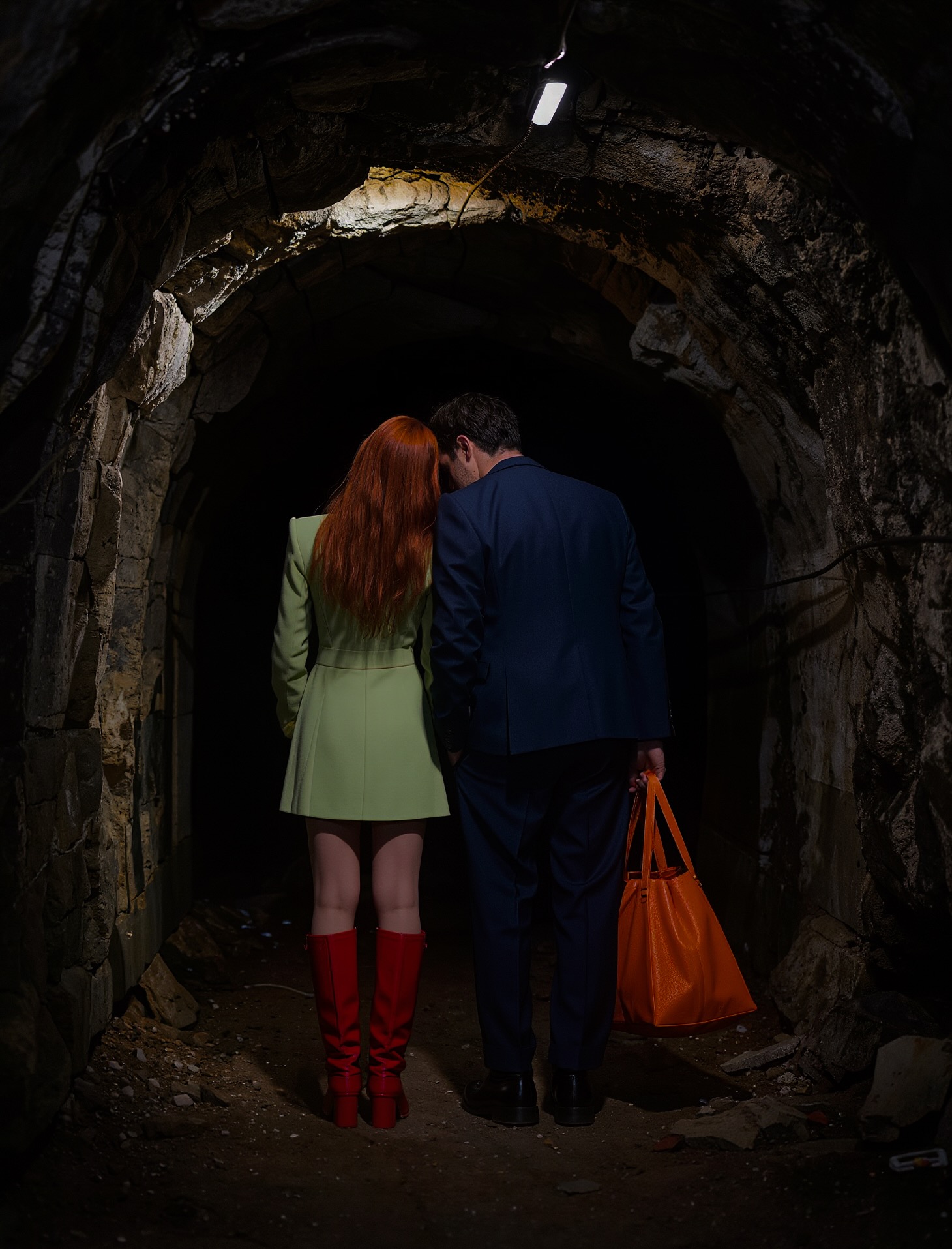
    He emerged from the woods into a narrow gully and saw the entrance to a tunnel—arched stone, bricked over in places, but with enough of a gap to squeeze through if one wanted to. She was there, standing in front of it, looking into the dark Her hair was wet and wild and the red boots were the only brightness in front of him. She walked towards the tunnel and then turned to look at him.

    “You found me,” she said, almost whispering.

    He tried to laugh, to shake off the performance, but she just watched him with that same clinical interest.

    “What is this?” he asked, meaning: What are we doing? But also, What happens now?

    She took a step back, until the blackness of the tunnel was a shroud behind her. “Do you want to see?”

    He hesitated. This felt, suddenly, like the axis on which the rest of his life would turn—like there was a right answer and a wrong one, and he had no way of knowing which was which.

    But he nodded, and stepped forward, and she turned and vanished into the dark.

    He followed.

    Inside, the air was still and ancient. He could feel the weight of the earth above, pressing down, and the only sound was their breathing, out of sync but close enough to suggest intimacy. She moved confidently, even in the dark, and he could only orient himself by the shape of her silhouette ahead.

    The tunnel narrowed and widened, sometimes requiring a stoop, sometimes opening into chambers with walls wet and sparkling. In places the floor was slick with mud, and once he nearly lost his footing, catching himself on a cold, unseen protrusion. She did not offer a hand or look back.

    Eventually she stopped. He was close enough to see the outline of her shoulders, the curve of her neck as she turned slightly toward him. And the red of her hair and boots. 

    “You know what happens next?” she asked, voice flat and uninflected.

    He said nothing, because he did not.

    She stepped closer. For the first time he could see her eyes, reflective and bottomless in the dark.

    “Why did you follow me?” she asked.

    He started to answer, but the words tangled. He wanted to say: Because I thought you wanted me to. Because I have always been the one who follows, never the one who leads. Because you made me feel visible for the first time in years, and I wanted more of that, even if it cost me everything”.

    She turned, reached up and touched his face, her hand cold and deliberate. She had something in her hand.

    “It’s okay,” she said, as if to a child.

    He didn’t pull away. He just closed his eyes. There was nothing else to do.

    When the pain came, it was less than he’d imagined, more a displacement, a loss of boundary than an injury. He felt himself collapse inward, like the old tunnel finally giving up its shape.

    He thought, fleetingly, of all the things he would never finish: the miniature armies half-painted on his desk, the campaign notes left unsorted, the private hope that one day someone would choose him not as a last resort but as a first option.

    He thought of her, and wondered whether she would remember his name.

    He doubted it.